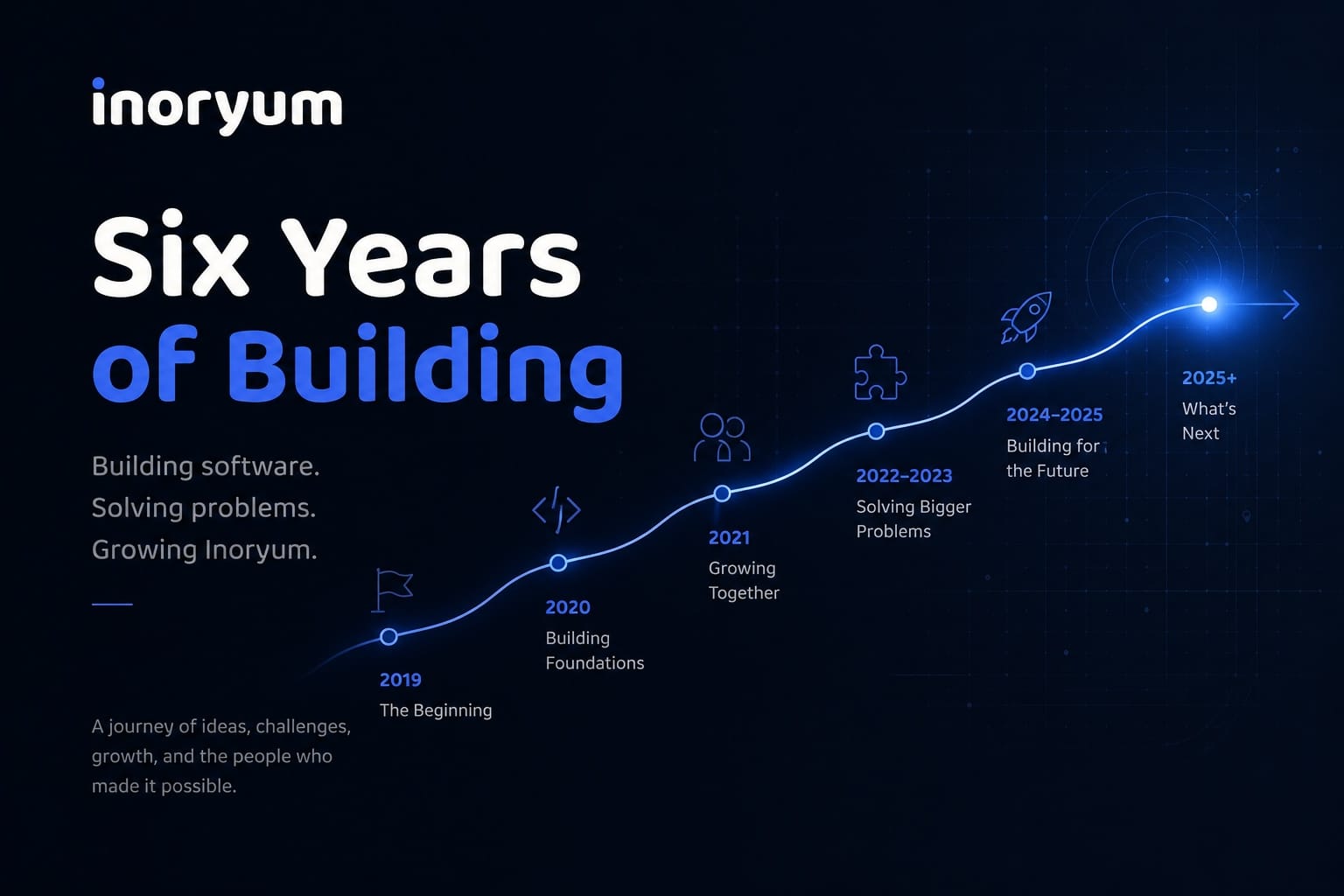
Six years ago, Inoryum was little more than an idea backed by curiosity, long nights, and a willingness to tackle problems that others often avoided.
At the time, we weren't thinking about building products or creating open-source software. We simply wanted to help businesses build better digital experiences. One project became another, one client introduced us to the next, and over time something interesting happened.
The problems became larger.
Not because clients were asking for more features, but because they were asking bigger questions.
"How do we scale this?"
"Can Ghost do this?"
"Can we automate this workflow?"
"How do we make memberships work for our business?"
"Can we build something that doesn't exist yet?"
Those questions ended up shaping the company far more than any business strategy ever could.
Building More Than Websites
Like many software companies, we started with websites.
But it didn't take long to realize that most businesses weren't looking for another website.
They were looking for solutions.
A publisher wanted contributor subscriptions that Ghost didn't support.
Another client needed region-specific pricing based on where readers were visiting from.
Someone else wanted to integrate a payment provider that had never been connected to Ghost before.
Another publication needed thousands of legacy comments migrated without losing years of community discussions.
Every project became an engineering challenge rather than a development task.
Instead of asking, "How do we build this page?"
We started asking,
"How should this system work?"
That small shift changed everything.
Becoming Known for Ghost CMS
One platform appeared in our work more than any other: Ghost CMS.
We admired its simplicity, speed, and publishing-first philosophy.
But like any software, real-world businesses often needed capabilities beyond what came out of the box.
Over the years, we've built custom Ghost themes, membership systems, middleware, editorial workflows, payment integrations, enterprise publishing solutions, and infrastructure for organizations across different industries.
Some projects were straightforward.
Others required designing entirely new systems around Ghost while keeping it at the center of the publishing experience.
Those experiences gradually earned us a reputation as Ghost CMS specialists—not because we set out to become experts, but because we kept saying yes to difficult problems and worked until we found solutions.
Every Client Taught Us Something
Looking back, one of the biggest surprises wasn't the technology.
It was the people.
We've had the privilege of working with independent creators, publishers, media organizations, nonprofits, educational platforms, membership businesses, and growing startups across different countries.
Each project came with its own goals, constraints, and expectations.
Some clients needed a quick solution.
Others trusted us with platforms that thousands of people depended on every day.
Every conversation, every challenge, and every successful launch added another lesson to how we think about software.
That's something no tutorial, certification, or textbook can replace.
The Best Ideas Came From Real Problems
One thing became impossible to ignore.
Different clients kept running into the same challenges.
Editorial workflows.
Membership management.
Publishing automation.
Asset organization.
Content distribution.
Research pipelines.
Instead of solving these problems over and over again for individual clients, we started asking a different question.
"What if we built the tools ourselves?"
That question marked the beginning of a new chapter for Inoryum.
From Services to Products
Today, client work remains an important part of our business.
Working closely with publishers and organizations keeps us grounded in real-world challenges.
But alongside that work, we're investing heavily in products that solve those challenges at a broader scale.
Some of those projects are already taking shape.
The Alpha Protocol explores autonomous publishing workflows powered by AI while keeping humans in control.
ColumnOS is our vision for a modern publishing operating system built around editorial teams rather than technical limitations.
Archivary helps publishers transform existing content into professionally designed books and digital publications without rebuilding everything from scratch.
AssetLane is focused on helping organizations better manage and organize their growing libraries of digital assets.
None of these products appeared overnight.
Each one exists because a real customer, at some point, encountered a problem worth solving.
Why Open Source Matters
Over the last few years, open source has become an increasingly important part of how we build.
Not because it's fashionable.
Not because it's good marketing.
But because some of the best software in the world exists thanks to communities willing to share knowledge, improve ideas, and build together.
Open source encourages transparency.
It invites collaboration.
It challenges assumptions.
Whenever it makes sense, we'd rather contribute back to the ecosystem than keep every solution locked behind closed doors.
We believe the future of publishing software should be shaped by people who actually use it.
Lessons From Six Years
If there's one thing these six years have taught us, it's that technology alone is never the answer.
The best software starts with listening.
The best engineering begins with understanding the problem before writing a single line of code.
Relationships matter more than invoices.
Trust is more valuable than marketing.
Shipping consistently beats chasing perfection.
And sometimes the smallest feature can have the biggest impact on someone's business.
Perhaps the most important lesson of all is this:
Building software is easy compared to building something people continue to trust year after year.
That's the challenge we enjoy most.
Looking Forward
Six years isn't the finish line.
It feels more like the foundation.
The publishing industry is changing rapidly.
AI is transforming workflows.
Independent media is growing.
Membership businesses are evolving.
New opportunities appear almost every month.
We're excited to continue building tools that help publishers, creators, and organizations spend less time fighting technology and more time creating meaningful work.
Whether that's through client partnerships, open-source projects, or products we're developing behind the scenes, our mission remains surprisingly similar to the one we started with six years ago.
Build software that solves real problems.
Everything else follows.
Thank you to every client, collaborator, contributor, and community member who has been part of this journey.
Your trust has shaped Inoryum far more than you probably realize.
Here's to the next chapter.